Unlock Your First Pull-Up: A Beginner’s Guide
Doing your first pull-up is one of the most exciting achievements in calisthenics. At first, hanging from a bar and pulling your body upward can feel almost impossible. You may be able to do push-ups and squats, but a pull-up requires a different combination of back strength, arm strength, grip, core control, and body coordination.
Your current strength doesn’t have to limit you; with consistent practice, you can work toward your first pull-up. You simply need the right progressions, consistent practice, and enough patience to allow your body to adapt. Instead of trying to force yourself over the bar, focus on building the strength needed for each part of the movement.
What Is a Pull-Up?
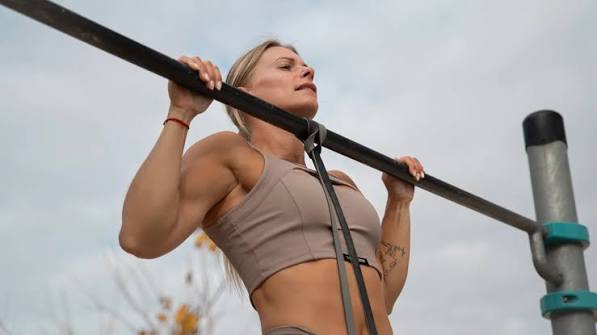
A pull-up is a bodyweight exercise where you hang from a bar and use your upper-body muscles to pull your body upward until your chin reaches above the bar.
The movement mainly works your:
- Back muscles
- Biceps
- Forearms
- Shoulders
- Core
- Grip
A proper pull-up is more than simply pulling with your arms. Your entire body needs to stay controlled throughout the movement. Learning how each part works together is what eventually makes your first pull-up possible.
Why Is Your First Pull-Up So Difficult?
Pull-ups can be challenging because you are moving almost your entire body weight against gravity. Unlike a machine exercise, there is no support helping you complete the movement.
You need enough strength to:
- Hold your body from the bar
- Keep a strong grip
- Stabilize your shoulders
- Engage your back
- Pull your body upward
- Control the movement back down
If you currently cannot do a pull-up, that does not mean you are weak. It simply means your body has not developed enough pulling strength yet.
Start With the Dead Hang
Dead hangs are a good starting point when you’re working toward your first pull-up.
Grab the pull-up bar with your palms facing away from you and allow your body to hang underneath it. Keep your grip firm and try to maintain control instead of simply hanging passively.
Dead hangs can help you develop the grip strength needed for future pull-ups.
Focus on:
- Holding the bar securely
- Keeping your shoulders controlled
- Maintaining a comfortable body position
- Increasing your hanging time gradually
Do not worry about holding the bar for a long time immediately. Even short holds can be useful when you are starting.
Build Your Back Strength
Your back plays a major role in a pull-up. If your back muscles are not strong enough, your arms will have to do too much of the work.
Exercises such as rows can help develop the pulling strength you need.
You can practice:
- Inverted rows
- Resistance-band rows
- Australian pull-ups
- Scapular pull-ups
These movements teach your body how to pull while gradually strengthening the muscles involved in a full pull-up.
Practice Scapular Pull-Ups
Scapular pull-ups are a useful progression because they teach you how to control your shoulders while hanging from the bar.
Grab the bar and hang with your arms straight to get into position.Without bending your elbows, gently pull your shoulder blades down and back. Your body should rise slightly.
The movement may look small, but it teaches an important part of the pull-up.
Focus on controlled movement rather than trying to lift your body as high as possible.
Use Assisted Pull-Ups
If you’re not ready for a full pull-up yet, assisted pull-ups can help you build the strength to get there.
You can use a resistance band or an assisted pull-up machine to reduce the amount of weight you need to pull.
The goal is not to make the exercise completely easy. Instead, choose enough assistance to perform the movement with good technique.
As you become stronger, gradually reduce the assistance.
This creates a simple progression:
As your strength improves, reduce the assistance step by step until you can perform a full pull-up using your own body weight.
That gradual approach allows your muscles to adapt without forcing you to attempt a movement that is currently too difficult.
Learn Negative Pull-Ups
Negative pull-ups are another excellent progression.
Instead of starting from the bottom and pulling yourself up, begin with your chin already above the bar. You can use a box or step to safely reach the starting position.
From there, slowly lower yourself toward the ground.
The downward portion of the movement is called the eccentric phase. Controlling this phase can help you develop the strength needed for a complete pull-up.
Try to make each repetition slow and controlled rather than simply dropping from the bar.
Improve Your Grip Strength
Your grip can become a limiting factor when learning pull-ups.
If you struggle to hold the bar, your grip may stop you from getting the most out of your pulling exercises.
You can improve your grip through:
- Dead hangs
- Farmer carries
- Towel hangs
- Bar holds
- Regular pulling exercises
You do not need to train your grip excessively. Just include some grip work regularly and gradually increase the challenge.
Keep Your Core Engaged
A strong core can make your pull-up more controlled.
Instead of allowing your legs to swing around, keep your body stable while pulling. Your abdominal muscles and other core muscles help prevent unnecessary movement.Exercises such as planks, hollow-body holds, and hanging knee raises can help improve core strength.A controlled body position also makes it easier to focus on the actual pulling movement.
Focus on Proper Pull-Up Form
Good technique is important when learning your first pull-up.
Hold the bar securely and keep your arms extended as you begin.Keep your body controlled and avoid excessive swinging.
Then:
- Engage your shoulders.
- Brace your core.
- Pull your elbows down toward your sides.
- Drive your body upward.
- Bring your chin over the bar.
- Lower yourself under control.
Do not rush through the repetition. A clean pull-up is more valuable than several messy repetitions.
Avoid These Common Mistakes
Many beginners make their progress harder by trying to do too much too soon.
Common mistakes include:
- Swinging the body to create momentum
- Using only the arms
- Neglecting grip training
- Skipping warm-ups
- Practicing without enough recovery
- Doing poor-quality repetitions
- Trying advanced variations too early
- Training inconsistently
Your goal should be to build strength gradually rather than prove how strong you are during every workout.
How Often Should You Practice?
You do not need to practice pull-ups every day.
For most beginners, practicing pulling movements around two to three times per week can provide enough stimulus while allowing time for recovery.
A simple session could include:
- Dead hangs
- Scapular pull-ups
- Assisted pull-ups
- Negative pull-ups
- Rows
- Core exercises
Focus on a few key exercises in each session instead of doing them all at once. Choose a few progressions that match your current level and focus on improving them over time.
How Quickly Can You Learn Your First Pull-Up?
There is no fixed timeline for learning a pull-up.Your progress can depend on factors such as your current strength, body weight, training experience, grip strength, recovery, and consistency.
Some beginners may achieve their first repetition relatively quickly, while others may need several months of focused training.
Instead of comparing your timeline with someone else’s, track your own improvements.Maybe you can hang for longer than before. Maybe your negative pull-up is becoming slower and more controlled. Maybe you need less resistance during assisted pull-ups.
These are all signs that you are getting closer.
Tips to Unlock Your First Pull-Up
Here are a few useful tips to help you improve your training:
- Practice consistently instead of training randomly.
- Start with a progression that matches your current strength.
- Focus on controlled repetitions.
- Strengthen your back and grip.
- Keep your core engaged.
- Gradually reduce assistance.
- Do not rely on excessive swinging.
- Give your muscles enough recovery time.
- Track your progress.
- Stay patient.
Even small improvements can eventually lead to your first full pull-up.
Frequently Asked Questions
Can beginners learn to do a pull-up?
Yes. Beginners can learn a pull-up by building the necessary grip, back, arm, shoulder, and core strength through easier progressions.
What is the best exercise to get your first pull-up?
The right exercise depends on your current strength and fitness level. Assisted pull-ups, negative pull-ups, dead hangs, rows, and scapular pull-ups are all useful progressions.
How often should I train for my first pull-up?
Around two to three focused sessions per week can be a good starting point for many beginners. Giving your body enough time to recover is just as important as the workout itself.
Why can I hang from the bar but not do a pull-up?
Hanging mainly tests your grip and shoulder endurance, while a pull-up requires you to generate enough pulling strength to move your body upward.
Should I use resistance bands to learn pull-ups?
Yes. Resistance bands can make pull-ups more accessible by reducing the amount of body weight you need to lift. As you become stronger, gradually use less assistance.
Why Choose ZENITHCALIS?
At ZENITHCALIS, we believe that progress starts with mastering the basics. Your first pull-up may seem difficult today, but with the right progression and consistent effort, you can gradually develop the strength and control needed to achieve it.
Whether you are working on your first pull-up, improving your bodyweight strength, or preparing for more advanced calisthenics skills, the goal is simple: train patiently, improve consistently, and keep moving forward.
Final Thoughts
Unlocking your first pull-up is not about being naturally strong. It is about developing the right muscles and practicing the movement consistently. Dead hangs can improve your grip, rows can strengthen your back, assisted pull-ups can help you practice the full movement, and negative pull-ups can teach you how to control your body.
Do not become frustrated if your first pull-up does not happen immediately. Every stronger hang, better negative, and cleaner assisted repetition is bringing you closer to the goal. Stay consistent, focus on good technique, recover properly, and trust the process.
Eventually, the movement that once seemed impossible can become one of the most satisfying skills you have achieved in calisthenics.