Best Calisthenics Workout for Beginners
Starting calisthenics can feel exciting, but it can also be confusing when you do not know which exercises to start with. You may see people performing advanced movements such as handstands, muscle-ups, and planches and wonder how you can reach that level.
The good news is that you do not need advanced skills when you are just starting. A beginner calisthenics workout should focus on simple bodyweight movements that help you build strength, control, balance, and confidence.
The best approach is to master the basics first and gradually make your training more challenging. With regular practice, proper technique, and enough recovery, you can build a strong foundation for more advanced calisthenics.
What Is Calisthenics?
Calisthenics is a type of resistance training that mainly uses your own body weight instead of traditional gym equipment.
Common exercises include:
- Push-ups
- Squats
- Lunges
- Rows
- Pull-ups
- Dips
- Planks
- Leg raises
These exercises can train several muscles at the same time while improving your ability to control your body.
One of the biggest advantages of calisthenics is its simplicity. You can perform many exercises at home, outdoors, or in a gym without needing expensive equipment.
Why Is Calisthenics Good for Beginners?
- Calisthenics is beginner-friendly because many exercises can be modified according to your current strength.
- For example, if a regular push-up is too difficult, you can begin with wall push-ups or incline push-ups. As you become stronger, you can gradually move toward standard push-ups.
- This allows you to progress at your own pace instead of trying to perform exercises that are currently too difficult.
Calisthenics can help beginners:
- Build basic strength
- Improve body control
- Develop balance
- Strengthen the core
- Improve mobility
- Increase muscular endurance
- Build confidence
- Learn proper movement patterns
- How Often Should Beginners Do Calisthenics?
Consistent training and proper recovery are more important than working out every day.
For most beginners, two to three workouts per week can be a practical starting point. This gives your body enough time to recover between demanding sessions.
For example:
- Monday: Full-body workout
- Tuesday: Rest
- Wednesday: Full-body workout
- Thursday: Rest
- Friday: Full-body workout
- Saturday: Light activity or mobility
- Sunday: Rest
You can adjust this schedule according to your lifestyle and recovery.
Consistency is more important than trying to train as often as possible.
Start With a Warm-Up
Start your workout with a short warm-up to prepare your muscles, joints, and body for exercise.
A warm-up can increase movement readiness and help you feel more comfortable during your exercises.
You can include:
- Arm circles
- Shoulder rolls
- Wrist movements
- Hip circles
- Bodyweight squats
- Light jogging
- Easy jumping jacks
Keep your warm-up simple. Around five to ten minutes is usually enough for a beginner session.
Push-Ups
- Push-ups are one of the best exercises for beginners because they train several upper-body muscles at once.
- They mainly work the chest, shoulders, and triceps while your core helps keep your body stable.
- If you cannot perform a regular push-up yet, start with an easier variation.
You can progress through:
- Push-Up Progression: Wall → Incline → Knee → Standard Push-Up
- Focus on controlled movement rather than trying to complete as many repetitions as possible.
- Keep your body aligned and avoid allowing your hips to drop or rise excessively.
Bodyweight Squats
- Squats are a basic lower-body movement that every beginner should learn.
- They primarily work your legs and glutes while also requiring core stability.
- Start with a comfortable stance and keep your chest controlled as you lower your body. Try to move smoothly rather than rushing through each repetition.
- As your strength improves, gradually increase repetitions or progress to more challenging squat variations.
Lunges
- Lunges are another useful exercise for developing lower-body strength and balance.
- They work the legs and glutes while requiring you to control your body through a single-leg movement.
- If standard lunges feel unstable, hold onto something for support while learning the movement.
- As your balance improves, you can perform lunges without assistance and eventually explore more challenging variations.
Glute Bridges
- Lie comfortably on your back, bend your knees, and keep both feet firmly planted on the floor.
- Get into position by lying on your back, bending your knees, and placing your feet flat on the ground.Lift your hips while keeping your movement controlled, then lower them slowly.
- Focus on using your glutes rather than simply moving your hips as quickly as possible.
- This exercise can also be useful for beginners who spend a lot of time sitting during the day.
Rows
- Pulling exercises are important because a balanced routine should train both pushing and pulling movements.
- Bodyweight rows can help beginners develop the back and arms while preparing them for more demanding pulling exercises.
- If you have access to a secure low bar or suitable equipment, rows can be adjusted to match your current strength.
- As you become stronger, you can work toward assisted pull-ups, negative pull-ups, and eventually your first full pull-up.
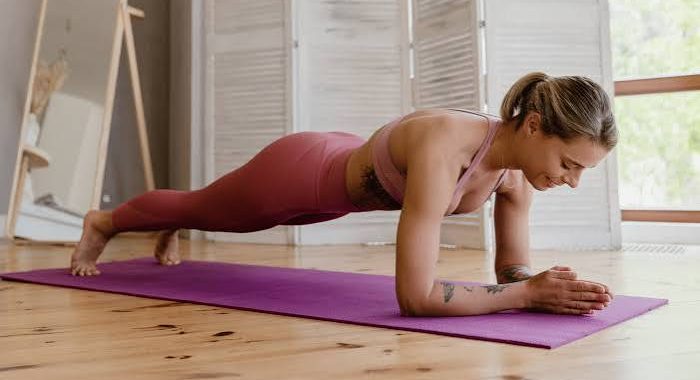
Planks
- A strong core helps you control your body during many calisthenics exercises.
- Planks are a simple starting point for developing core endurance.
- Keep your body in a straight line and avoid letting your hips drop toward the floor.
- Instead of holding the position for as long as possible, focus on maintaining good form.
- As your core becomes stronger, you can gradually increase your holding time.
Beginner Calisthenics Workout
You can combine these exercises into a simple full-body session.
Beginner Workout
1. Incline or regular push-ups
2–3 sets of 6–12 repetitions
2. Bodyweight squats
2–3 sets of 10–15 repetitions
3. Bodyweight rows
2–3 sets of 6–12 repetitions
4. Lunges
2–3 sets of 8–12 repetitions per leg
5. Glute bridges
2–3 sets of 10–15 repetitions
6. Plank
2–3 sets of 20–40 seconds
Rest for around 60–120 seconds between sets, adjusting the rest period according to your fitness level.
You do not need to perform every exercise at maximum effort. The goal is to learn the movements, build a training habit, and gradually become stronger.
How to Progress as a Beginner?
Your first workout will eventually become easier. When that happens, you need to give your muscles a new challenge.
This is called progressive overload.
You can progress by:
- Adding repetitions
- Adding another set
- Improving your technique
- Slowing down each repetition
- Using a harder exercise variation
- Reducing assistance
For example, if you start with incline push-ups, you might eventually progress to regular push-ups and then more challenging variations.
The goal is not to make every workout extremely difficult. Instead, increase the challenge gradually as your ability improves.
Do Not Ignore Pulling Exercises
Many beginners focus heavily on push-ups and squats but forget about pulling movements.
A balanced calisthenics routine should include both pushing and pulling exercises.
Pulling movements can strengthen:
- Upper back
- Lats
- Biceps
- Forearms
- Grip
If you cannot perform a pull-up yet, do not worry. Start with rows, dead hangs, assisted pull-ups, and negative pull-ups.
Over time, these exercises can help you develop the strength needed for your first full repetition.
Recovery Is Part of Training
Beginners sometimes believe that training every day will produce faster results. In reality, your body needs time to recover after challenging exercise.
During recovery, your body adapts to the training stimulus and prepares for your next session.
Focus on:
- Getting enough sleep
- Eating nutritious food
- Drinking enough water
- Taking rest days
- Avoiding excessive training
Recovery becomes especially important when you start increasing your workout intensity.
Common Beginner Mistakes
Avoiding common mistakes can make your calisthenics journey easier.
Some beginners:
- Try advanced skills too early
- Focus on repetitions instead of technique
- Train without enough recovery
- Ignore their legs
- Avoid pulling exercises
- Change their routine too frequently
- Expect results immediately
- Compare their progress with others
Instead, focus on mastering basic movements and improving gradually.
Your starting point does not matter as much as the direction you are moving in.
Frequently Asked Questions
Is calisthenics good for complete beginners?
Yes. Calisthenics can be adapted to different fitness levels, making it suitable for people who are new to exercise.
How many days a week should a beginner do calisthenics?
Two to three full-body workouts per week can be a good starting point. You can increase training frequency as your fitness and recovery improve.
Can beginners build muscle with calisthenics?
Yes. Challenging bodyweight exercises can stimulate muscle development, especially when you gradually increase the difficulty of your training.
Do I need equipment?
No. Many beginner exercises require no equipment. However, a pull-up bar, resistance bands, or gymnastic rings can give you more options as you progress.
How long should a beginner workout last?
A focused workout of around 30–60 minutes can be enough for many beginners. The quality of your training matters more than making the workout unnecessarily long.
Why Choose ZENITHCALIS?
At ZENITHCALIS, we believe that everyone should have the opportunity to become stronger using simple and practical training methods.
Whether you are learning your first push-up, building the strength for your first pull-up, or simply trying to become more active, our goal is to make calisthenics easier to understand.
Start with the basics, focus on good technique, and build your strength one step at a time.
Final Thoughts
The best calisthenics workout for beginners does not need to be complicated. A combination of push-ups, squats, lunges, rows, glute bridges, and core exercises can provide a strong foundation for your fitness journey.
Start with exercises that match your current ability and focus on performing each movement with control. As you become stronger, gradually increase repetitions, sets, or exercise difficulty.
Most importantly, be patient with yourself. You may not perform a perfect push-up or pull-up on your first attempt, and that is completely normal.
Train consistently, master the basics, recover properly, and keep progressing. Your strongest version is built one repetition at a time.